Most developer teams adopting minimalist coding loops quickly discover that an off-the-shelf harness fails the moment it hits legacy monorepos. Standard runtimes rely on an immutable set of four core tools and expect flat directory structures, leaving engineers blind when custom security boundaries or pre-commit validations are required.
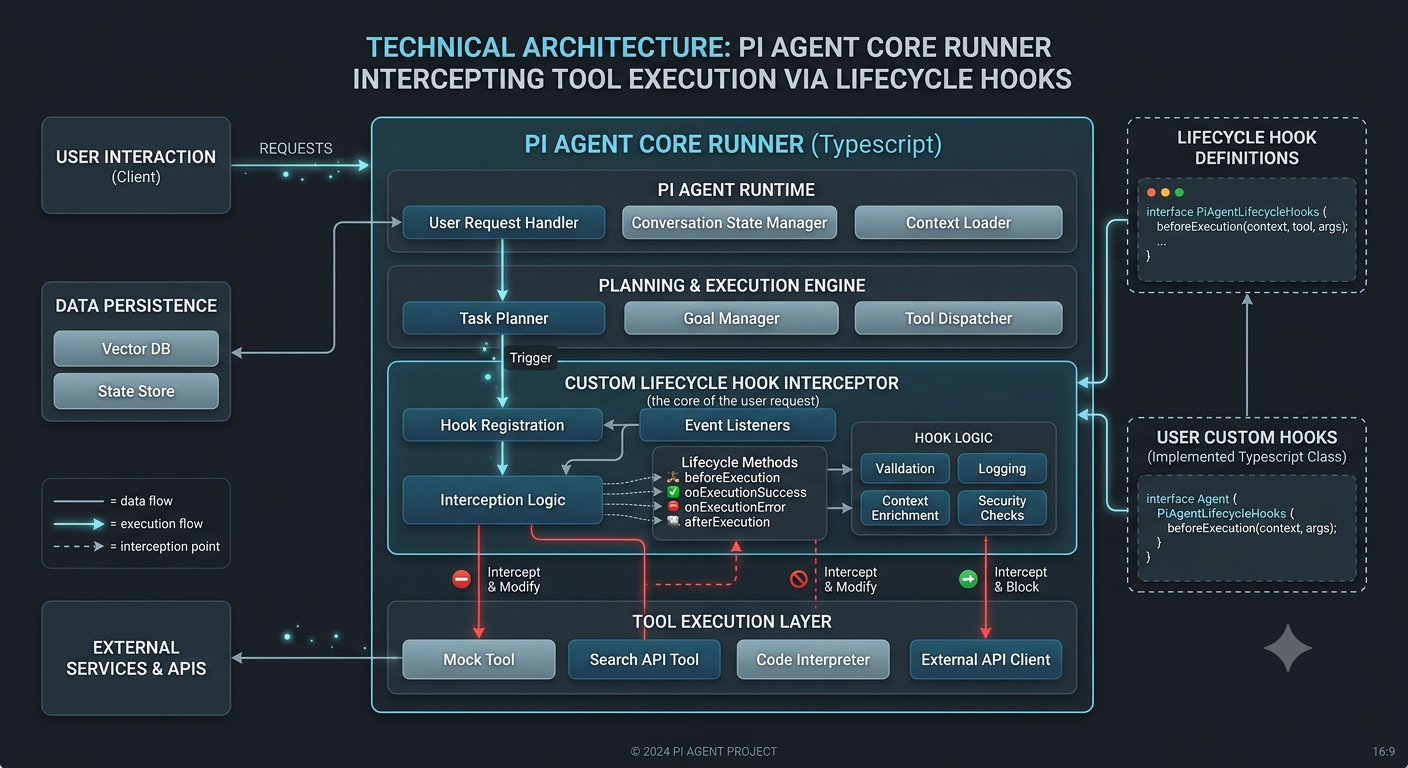
Writing custom TypeScript extensions and lifecycle hooks for pi agent bridges this gap, letting teams inject deterministic checks directly into the agent runtime without bloating the system prompt. By hooking into the DAG execution loop, developers gain surgical control over tool arguments, state persistence, and output validation while keeping token expenditure flat.
Working through production deployments revealed that relying on standard event emitters causes race conditions during multi-file refactoring tasks. This deep-dive details how to construct stateful, type-safe extensions that survive asynchronous interruptions and maintain strict execution guarantees in production.
Infrastructure and Setup#
Configuring a robust extension environment starts with pinning the core runtime dependencies and establishing strict TypeScript compilation rules. Because extensions execute inside the agent’s main event loop, loose typing or unhandled promise rejections will crash the entire session state tree.
Setting up the project requires importing the exact typings from @earendil-works/pi-agent-core to ensure that custom hook signatures align with the runtime’s internal dispatcher. Avoid loose any declarations on hook payloads; the event context objects carry stateful references that mutate across tool execution phases.
import { AgentRuntime, HookContext, ToolExecutionEvent } from '@earendil-works/pi-agent-core';
import { promises as fs } from 'node:fs';
import * as path from 'node:path';

export interface SecurityConfig {
  allowedPaths: string[];
  blocklistPatterns: RegExp[];
}
Initializing the extension harness inside an enterprise repository demands an explicit configuration loader that validates path boundaries before the runtime initializes its first tool call. Skipping this validation phase invites arbitrary file modifications during unsupervised background refactoring runs.
Core Implementation Strategy#
Registering lifecycle hooks involves attaching middleware functions to specific interception points within the agent execution lifecycle. The core runtime exposes hooks such as beforeToolCall, afterToolExecution, and agentStart, each designed to inspect or mutate runtime parameters synchronously or asynchronously.
Implementing a production-grade file modification guard requires intercepting the write and edit tool calls before they hit the disk. The following pattern inspects incoming arguments and strips out unauthorized path traversal attempts.
export function registerSecurityExtension(runtime: AgentRuntime, config: SecurityConfig) {
  runtime.hook('beforeToolCall', async (context: HookContext) => {
    if (context.toolName === 'write' || context.toolName === 'edit') {
      const targetPath = path.resolve(context.args.path);
      const isAllowed = config.allowedPaths.some(p => targetPath.startsWith(path.resolve(p)));

      if (!isAllowed) {
        throw new Error(`Security violation: Modification of ${targetPath} is prohibited by runtime extension.`);
      }
    }
  });
}
Managing state across multiple tool iterations requires leveraging the context store attached to the session DAG. Instead of relying on module-scoped global variables - which fail during concurrent worker threads - extensions must read and write state directly through the provided telemetry context object.
Handling the Edge Cases#
Asynchronous steering messages and concurrent tool dispatches introduce subtle race conditions that break naive extension implementations. When an agent triggers multiple parallel read operations alongside a disruptive write hook, promise resolution order can cause state desynchronization.
Debugging these timing failures requires wrapping hook bodies in explicit serialization blocks or utilizing atomic lock mechanisms within the extension state store. If an agent execution is abruptly interrupted by a user cancellation signal, cleanup handlers must release file descriptors and clear pending timers immediately.
let activeOperations = new Map<string, Promise<any>>();

export function wrapAsyncHook(runtime: AgentRuntime) {
  runtime.hook('afterToolExecution', async (context: ToolExecutionEvent) => {
    const lockKey = `${context.sessionId}-${context.toolName}`;
    if (activeOperations.has(lockKey)) {
      await activeOperations.get(lockKey);
    }

    const task = performTelemetryFlush(context);
    activeOperations.set(lockKey, task);
    try {
      await task;
    } finally {
      activeOperations.delete(lockKey);
    }
  });
}
Ignoring these concurrency bottlenecks leads to silent data corruption inside the session ledger, forcing hard resets of the agent workspace and losing hours of accumulated context state.
Performance and Cost Optimization#
Minimalist runtimes derive their primary advantage from keeping system prompt token counts under one thousand tokens and maintaining sub-millisecond loop latency. Bloating custom extensions with heavy telemetry libraries or synchronous blocking I/O destroys this performance profile.
Optimizing extension overhead involves stripping out unnecessary dependency trees, caching configuration lookups, and offloading heavy log serialization to background worker threads. Every millisecond spent inside a lifecycle hook directly impacts the interactive responsiveness of the coding loop.
const telemetryBuffer: string[] = [];
const BATCH_SIZE = 50;

function optimizedLog(eventData: object) {
  telemetryBuffer.push(JSON.stringify(eventData));
  if (telemetryBuffer.length >= BATCH_SIZE) {
    flushBufferToDisk(telemetryBuffer.splice(0, BATCH_SIZE));
  }
}
Keeping the memory footprint flat ensures that long-running background agent sessions do not suffer from garbage collection pauses that interrupt active code generation phases.
Verification and Security Protocols#
Deploying custom TypeScript extensions into production pipelines mandates rigorous integration testing to prove that malicious or malformed agent outputs are caught before execution. Unit testing individual hooks requires mocking the HookContext and simulating edge cases like invalid JSON payloads and missing argument structures.
describe('Security Extension Tests', () => {
  it('blocks unauthorized file writes outside allowed paths', async () => {
    const mockRuntime = new MockAgentRuntime();
    registerSecurityExtension(mockRuntime, { allowedPaths: ['/app/src'], blocklistPatterns: [] });

    const context = { toolName: 'write', args: { path: '/etc/passwd', content: 'hack' }, sessionId: 'test-1' };
    await expect(mockRuntime.trigger('beforeToolCall', context)).rejects.toThrow('Security violation');
  });
});
Enforcing these verification protocols guarantees that extending the runtime does not introduce new attack surfaces into automated CI/CD environments or developer workstations.
Summary#
Extending developer agents requires balancing deep runtime access with strict performance and security boundaries. By leveraging typed lifecycle hooks and avoiding global state mutations, teams can tailor the execution environment to enterprise standards without compromising loop speed.
Actionable engineering steps include pinning core runtime imports, validating all file modification paths before disk writes, serializing asynchronous hook operations to prevent race conditions, and maintaining a flat memory profile to protect prompt budgets.